

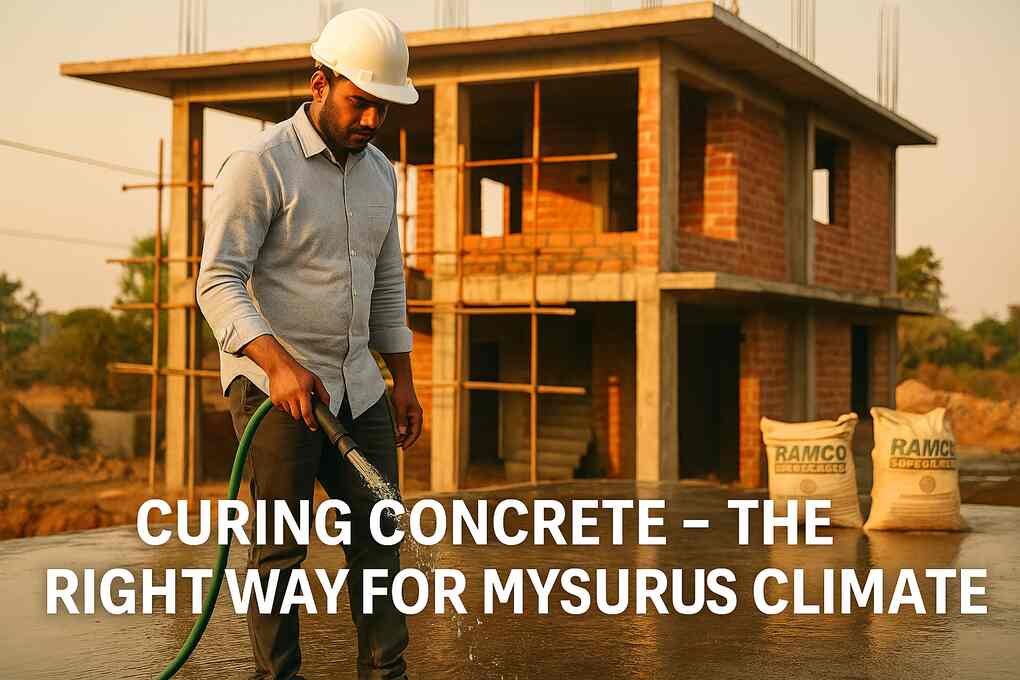
- Written by: heritagebuilders
- November 10, 2025
- Categories: Construction, Building
- Tags: , Curing Concrete, Mysuru’s Climate
A practical guide from the engineers at Heritage Builders
Introduction
Curing is one of the simplest yet most critical steps in achieving durable concrete. Unfortunately, it’s also the step most frequently rushed or misunderstood at construction sites. In a city like Mysuru, where the climate swings between warm summer days, cool nights, and long humid monsoons, curing demands a careful, climate-specific approach.
At Heritage Builders, our engineers often remind clients that the strength of any structure depends not just on how well it’s cast, but on how well it’s cured. Here’s a complete guide to curing concrete the right way for Mysuru’s weather conditions.
1. What Is Concrete Curing – and Why It Matters
When concrete is poured, the cement within it reacts chemically with water — a process called hydration. This reaction builds the internal crystal structure that gives concrete its strength.
If water evaporates too early, the hydration stops prematurely, leading to cracks, surface dusting, and weak structural strength.
Curing keeps concrete moist and at the right temperature long enough for this hydration to complete properly.
According to IS 456:2000, concrete should be cured for:
- Minimum 7 days when using ordinary Portland cement (OPC)
- 10–14 days for blended cements (PPC or PSC)
- Ideally 28 days for full strength and durability
2. How Mysuru’s Climate Affects Concrete Curing
Mysuru’s weather has a character of its own:
- Temperature: 18 °C to 34 °C through the year
- Humidity: 50 %–80 %
- Rainfall: June to October monsoon, followed by dry spells
Such variation affects curing directly.
- During summer, high day temperatures accelerate surface drying, causing micro-cracks.
- In monsoon months, excess moisture can stagnate on slabs or walls, weakening surface layers.
- Cool nights slow down the hydration rate, so curing needs to be more frequent during the day.
Our engineers schedule curing early in the morning and again late evening to balance temperature and moisture loss.
3. Ideal Curing Duration for Mysuru Conditions
Curing time should match both the concrete element and the local weather.
| Element | Recommended Duration | Remarks |
| Footings / Columns | 7 – 10 days | Keep wrapped with wet gunny bags |
| Beams / Roof Slabs | 14 – 21 days | Ponding method preferred |
| Plastered Walls | 10 – 14 days | Avoid over-watering; maintain dampness |
| Exposed Driveways / Pavers | 7 – 10 days | Prevent direct sunlight initially |
Longer curing — especially for slabs and roofs — ensures higher surface strength and reduces shrinkage cracks common in Mysuru’s dry-heat months.
4. Practical Curing Methods That Work Locally
a) Water Ponding
Ideal for horizontal surfaces like slabs. Create small clay or sand barriers (bunds) and keep 25–50 mm of water standing for 10–14 days.
b) Gunny Bag Wrapping
For vertical elements such as columns and walls, wet jute bags retain moisture evenly. They must be re-wetted twice a day.
c) Sprinkler / Hose Curing
Common for larger sites where manual labour is limited. Ensure even spraying without washing off the surface mortar.
d) Curing Compounds
In areas facing water scarcity or labour shortage, membrane-forming curing compounds can be sprayed to reduce evaporation. Our engineers, however, prefer using these selectively — never as a total substitute for water curing.
💡 Pro tip: Avoid using bore-well water that has high mineral content; it can leave white salt marks (efflorescence) on finished surfaces.
5. Seasonal Adjustments for Mysuru
- ☀️ Summer (March–May):
Cover fresh concrete immediately after finishing with damp hessian sheets. Begin curing within 2 hours of casting. Re-wet every 2–3 hours on the first day, then twice daily. - 🌧️ Monsoon (June–October):
Natural rainfall helps, but ensure water doesn’t stagnate or wash off surface cement. Cover exposed concrete during heavy showers. - 🌤️ Winter (November–February):
With mild daytime temperatures, extend curing duration by a few extra days. Early-morning dew can help maintain surface moisture, but protect concrete from cold nighttime drafts.
6. Common Myths & Mistakes
❌ Myth 1: Three days of curing is enough.
Even if concrete feels hard, hydration continues beneath the surface. Stopping early leads to invisible micro-cracks that later become seepage lines.
❌ Myth 2: Rainwater takes care of curing automatically.
Rain helps retain moisture but can also cause surface erosion or patchy curing. Controlled water application is still essential.
❌ Myth 3: More water means stronger concrete.
One of the most frequent issues we see is over-curing. Many enthusiastic owners insist on watering their structure three or four times a day — sometimes even doing it themselves. Once the surface is already moist, excessive watering adds no strength. Instead, it keeps walls and slabs damp for too long, encouraging fungal or algae growth on plastered surfaces, especially in shaded corners. It can also cause efflorescence — the white salty stains you see on compound walls.
Our engineers recommend maintaining consistent moisture, not flooding. Two to three well-timed sessions a day are sufficient. Quality curing is about control, not quantity.
❌ Myth 4: Curing compounds can fully replace water.
They help reduce evaporation but must be used as part of a structured curing plan — not a shortcut.
7. The Heritage Builders Way
At Heritage Builders, we treat curing as a scientific process, not a routine.
Our site teams:
- Follow checklists based on IS codes and site conditions.
- Schedule curing early morning and evening to minimise evaporation.
- Ensure water quality and even distribution across all surfaces.
- Track curing logs daily to guarantee structural integrity.
This disciplined approach ensures that every structure we hand over meets long-term durability standards — no hairline cracks, no surface dusting, and no fungal patches months later.
Conclusion
Concrete doesn’t gain strength overnight — it grows stronger with care, consistency, and correct curing. In Mysuru’s balanced yet unpredictable climate, managing that moisture window is what separates good construction from great construction.
Our engineers at Heritage Builders believe:
“Strength is built at casting, but ensured through curing.”
If you’re planning your dream home or commercial project in Mysuru, talk to our team. We’ll make sure every drop of water used in curing truly adds to the life of your building.