

- Written by: heritagebuilders
- November 28, 2025
- Categories: Industry, Construction, Real Estate
- Tags:
Greater Mysuru is no longer an idea — it’s happening.
Over the last few months, the conversation around “Greater Mysuru” has moved from drawing boards and newspaper debates to actual proposal pushes, government discussions, and on-ground planning.
For homeowners, landowners, and builders like us, this shift is not just administrative — it will reshape how Mysuru grows for the next 20–30 years.
At Heritage Builders, we’ve been tracking this closely because every change in city limits, infrastructure, and building regulations directly affects how homes should be planned and built going forward.
So here’s a simple, practical breakdown of what Greater Mysuru means and why it matters right now.
1. What is Greater Mysuru? (In simple words)
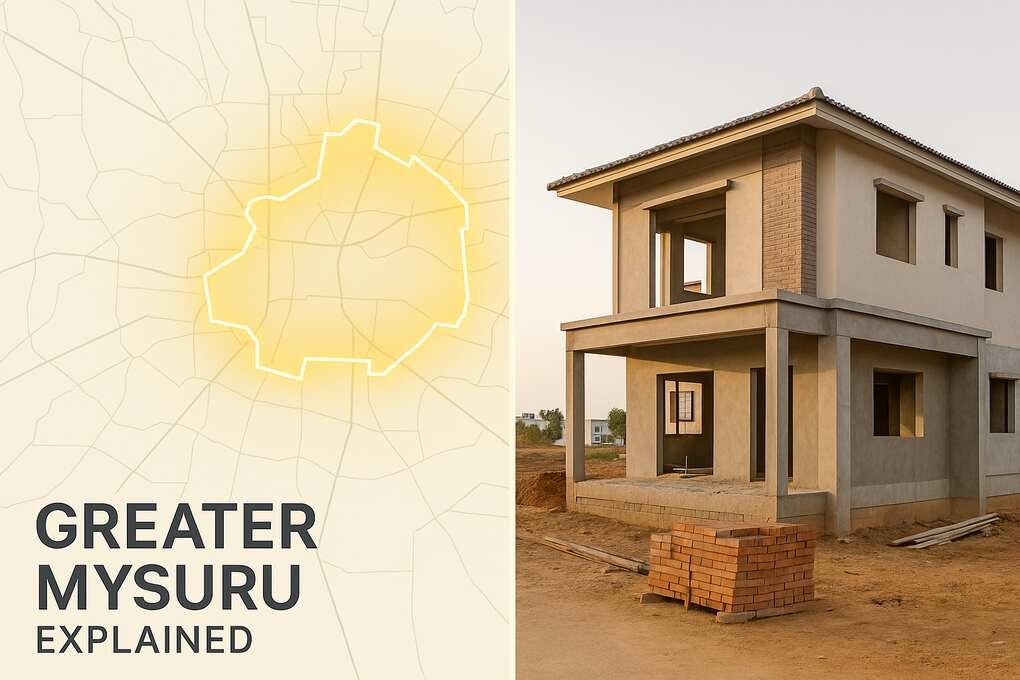
Greater Mysuru is a proposal to expand the Mysuru City Corporation (MCC) by merging nearby towns, town panchayats, and fast-growing outskirts into one unified civic body.
Today, Mysuru city is limited to core zones.
But rapid growth has already pushed development towards:
-
Bogadi
-
Hootagalli
-
Ilavala
-
Koorgalli
-
Srirampura
-
Kadakola
-
JP Nagar Outer Belt
-
Chamundi foothills zone
-
Jayapura Road stretch
These outer belts function like extensions of the city but do not receive MCC-level infrastructure and planning.
Greater Mysuru intends to change this.
The goal:
Create a larger, more capable, better-funded city with unified governance, clear building rules, stronger infrastructure, and strategic expansion planning.
2. Why is this expansion happening now?
a) City growth has already crossed old boundaries
Layouts, apartments, commercial buildings — everything has extended beyond MCC limits.
b) Infrastructure needs upgrading
Sewage, water supply, roads, and waste management in outer belts are lagging behind urban demand.
c) Access to larger government funds
Upgrading Mysuru to a higher city grade brings more grants and central schemes.
d) Reduce the “Bengaluru mistake”
The state wants Mysuru to grow but with planning, ensuring the city doesn’t face the uncontrolled expansion Bengaluru suffered.
e) Preparing for future population growth
With industries, IT, education, and tourism expanding, Mysuru is expected to nearly double in size over the next decade.
3. Which areas are likely to come under Greater Mysuru?
Based on current proposals and public discussions, the zones expected to merge include:
-
Hootagalli CMC
-
Bogadi Town Panchayat
-
Srirampura
-
Kadakola
-
Chamundi Hill surroundings
-
Jayapura and Ilavala zones
-
Koorgalli industrial belt
-
Parts of Hunsur Road outskirts
-
Belavadi and Kergalli belt
These regions already behave like “functional Mysuru,” so bringing them under MCC will create uniform planning and infrastructure standards.
4. Future Infrastructure That Will Shape Greater Mysuru
This is where things get exciting — because the expansion is tied directly to major infrastructure upgrades.
a) 105+ km Peripheral Ring Road (PRR)
The PRR is designed to create a massive loop around the expanded city — improving connectivity and reducing congestion.
What it means for homeowners:
-
Better road access
-
Faster travel to industrial hubs
-
Higher land value in outer belts
-
New real estate hotspots
b) Road Widening + New Link Roads
Expect new link roads between layouts, wider main roads, and smoother traffic within newly included zones.
Homeowners benefit through:
-
Less congestion
-
Better accessibility
-
Higher appreciation for corner plots and layout-facing properties
c) Upgraded Sewage & Drainage (UGD)
Outer belts currently rely on basic or independent sewage systems.
Greater Mysuru will bring them under city-grade UGD.
This means:
-
Better sanitation
-
Smoother building approvals
-
Higher construction compliance
d) Improved Water Supply Network
Bringing outskirts under MCC means more consistent water supply planning, fewer shortages, and improved infrastructure.
e) Smart City Extensions
Some Smart City upgrades already inside MCC (lighting, pavements, CCTV, cycling tracks) may extend outward.
5. How Home Approvals & Taxes May Change
Once these areas come under MCC, here’s what homeowners can expect:
a) Building Plan Approval Process
Approval may become:
-
Faster
-
Digital
-
Stricter (setbacks, FAR, parking rules)
-
More standardised
Builders like us already follow these standards, so the shift is positive.
b) Property Tax Changes
Yes — tax will increase in newly added areas.
But in return, you get:
-
UGD
-
Better roads
-
City water
-
Streetlights
-
Garbage collection
-
Higher civic service quality
In real estate terms, property value increases more than the tax increase.
c) FAR (Floor Area Ratio) adjustments
Some areas may allow higher FAR, enabling more floors depending on road width.
This will attract investors and homeowners planning future extensions.
d) Regularisation of earlier deviations
Many outer-area buildings were built without proper approvals.
Greater Mysuru may offer regularisation windows or stricter enforcement.
6. Why Buying or Building Now Is a Strategic Advantage
This is the part most people overlook.
As soon as Greater Mysuru becomes official, three things will immediately happen:
1. Land prices in outer areas will shoot up
Real estate reacts instantly.
Buying or building today means you beat the price spike.
2. Approval rules may become stricter
If you build now, you follow current rules.
After expansion, new FAR, setbacks, elevation rules may add complexity and cost.
3. Construction costs may increase after 2025
Because:
-
Labour demand increases
-
Regulation compliance increases
-
Material logistics may change
Build now → lock today’s cost.
Build after expansion → expect upward revision.
7. Heritage Builders’ Take: Homes Must Be Future-Ready
Greater Mysuru is not just a boundary change — it’s a shift toward a more urban, better regulated, and infrastructure-rich Mysuru.
We approach construction with this future mindset.
What future-ready means to us:
-
Stronger foundations for long-term expansion
-
Better waterproofing and drainage alignment
-
Electrical layouts that support EV charging
-
Solar-ready roof planning
-
Smart home wiring options
-
Proper rainwater harvesting
-
High-quality curing (critical in Mysuru’s climate)
-
Sustainable material choices
-
Attention to building compliance
We don’t just build for “handover day.”
We build for the next 25–40 years — which is exactly the timeline Greater Mysuru will influence the most.
Final Thought
Greater Mysuru is coming — slowly, steadily, and with long-term positive impact.
For homeowners, this is the moment to act smart:
-
Buy before prices rise
-
Build before regulation tightens
-
Plan a home that matches future infrastructure
If you want clarity on how this expansion affects your specific site, locality, or construction budget, our engineers at Heritage Builders can give you a personalised, ground-reality assessment.